

Monday, June 22, 2026
AI Analysis of 2025 Arizona Telescope Unveils New Ganymede Insights
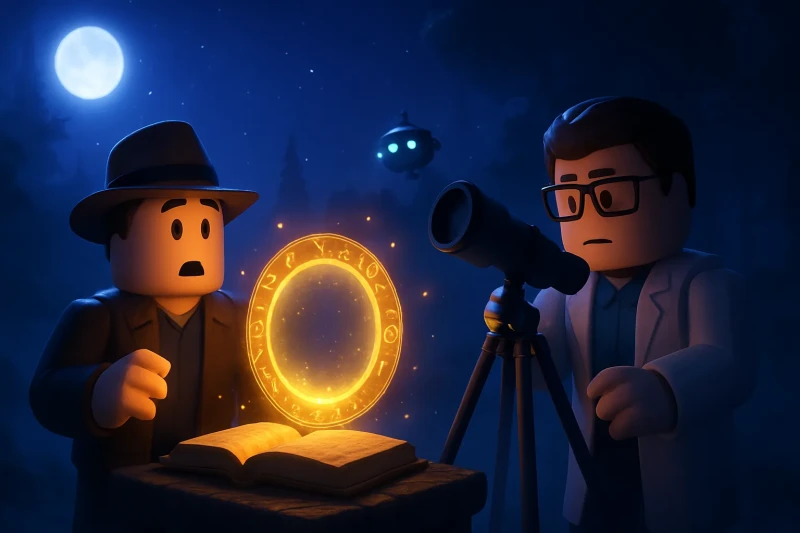
The Arizona night was veiled in a dense, cosmic silence. Stars shimmered above like distant echoes of ancient fires, casting faint glows over the desert landscape. Amidst this tranquil backdrop, a lone figure adjusted his telescope, eyes fixed on a point where time and space intertwined. Andrew McCarthy was about to unveil a hidden wonder, capturing an image that would ripple through the scientific community. The target of his nocturnal quest was Ganymede, Jupiter's largest moon—a celestial giant cloaked in mystery.
As McCarthy peered through his lens into the abyss, he did not merely glimpse at Ganymede; he revealed it in unprecedented detail from Earth’s surface—a feat previously reserved for advanced observatories or deep-space probes. His backyard discovery seemed to defy conventional wisdom and beckoned an array of questions: How could such clarity be achieved with amateur equipment?
🌌 The Discovery
On December 5, 2025, Andrew McCarthy posted an image on social media that quickly garnered attention. Using an 11-inch telescope from his Arizona backyard, he captured a highly detailed view of Ganymede alongside Jupiter's atmospheric bands. This remarkable achievement highlighted both the capability of modern amateur astronomy and the still-vast unknowns surrounding our solar system.
🤖 AI Decodes the Evidence
Various theories emerged following McCarthy's revelation. Some suggested atmospheric conditions played a pivotal role—perhaps unusually stable air allowed light to travel without distortion. Others speculated about advanced image processing techniques that might enhance raw data far beyond typical capabilities. Yet another line of thought considered whether unrecognized physical phenomena could have amplified the observed clarity.
This confluence of hypotheses underscores a broader enigma: do we fully understand the variables at play when observing celestial bodies from Earth?
🔬 Scientific or Historical Context
Astronomical history is replete with breakthroughs borne from serendipitous observations—from Galileo’s early telescopic discoveries to Hubble's deep field views revealing galaxies billions of light-years away. Each instance has expanded our cosmic comprehension and challenged existing paradigms.
Might McCarthy's findings herald another pivot point in our understanding? Could there be undiscovered principles guiding how light interacts with planetary atmospheres?
💭 Unresolved Questions
- What specific atmospheric conditions facilitated this exceptional visibility?
- Can amateur astronomers replicate these results consistently worldwide?
- Might similar techniques reveal new details about other celestial bodies?
The cosmos continues to guard its secrets closely—how many more await just beyond our current grasp?
🚀 What the AI Suggests
The AI posits that further exploration into adaptive optics could refine earthly telescopic observations even more profoundly than anticipated today. Such advancements might unlock yet unseen mysteries within our solar system—and beyond—by reducing atmospheric distortion effects significantly.
🧠 Final Reflection
This unexpected glance into Ganymede invites us to reconsider what amateur astronomers can achieve under optimal conditions and innovative methods. As technology advances, what other cosmic truths might become visible through newfound lenses?

Create all your AI images, videos, and stories in one place — OpenArt.
Favorite
-
-
AI Analysis Explores 3I/ATLAS Comet's Intriguing Cosmic Secrets
-
AI Analyzes Eerie September 2023 Lights Near Cape Disappointment
-
AI Explores 2023 St. Helens Luminescent Ocean Phenomenon
-
AI Questions 2025 Blackwater Bay Aurora Anomaly's True Origin
-
AI Analyzes 2025 Loch Ness Sonar Anomaly, Questions Historic Accounts